Choosing the Right Commercial Roofing System
A commercial roof is a major investment, and the system you choose affects everything that follows — how long it lasts, what it costs to run, how much maintenance it needs, and how well it protects what's underneath. Get it right and the roof quietly does its job for decades. Get it wrong and you're back on the roof far sooner than you should be.
For businesses across Griffith, the Riverina, and regional NSW, the "best" commercial roofing system isn't a single product — it's the one that suits your building, your use, and your local conditions. This guide walks through the factors that actually matter, so you can make a confident, informed decision.
- Your building and how it's used — what's inside sets the requirements before you look at a single sheet.
- Roof pitch — the slope of your roof rules some systems in and others out.
- Local conditions and total cost — heat, wind, corrosion, and lifetime value, not just the upfront price.
Start With the Building, Not the Roof
The right system starts with what the building does. A cold store, a machinery workshop, a retail space, and an agricultural shed all place different demands on a roof — for insulation, ventilation, spanning, and durability. Before anyone talks profiles or coatings, the question is: what does this building need to keep doing well? That's why choosing a commercial roofing system always begins with an assessment, not a catalogue.
Your Roof Pitch Decides a Lot
One of the most important — and least understood — factors is roof pitch. Low-slope commercial roofs shed water slowly, so they need profiles engineered to stay watertight at shallow angles, such as concealed-fixed or standing-seam systems. Steeper roofs open up more options. Put the wrong profile on the wrong pitch and water finds its way in — which is exactly the kind of costly mistake a professional assessment prevents.
The Main Metal Profiles, Compared
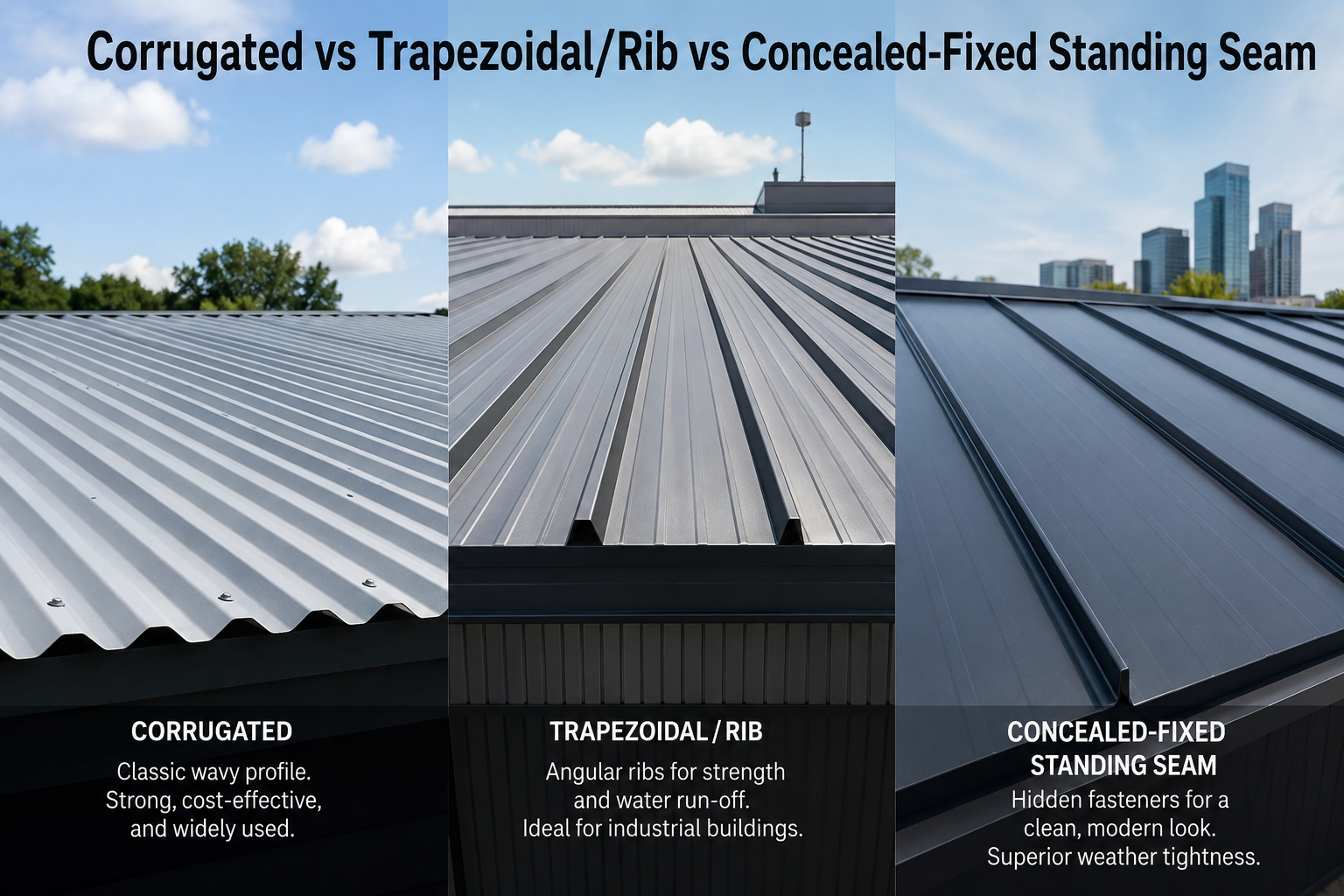
Most commercial and industrial roofing in NSW is metal. The three profiles below cover the vast majority of buildings — each with its own strengths, pitch suitability, and look.
Corrugated
The classic wavy profile. Strong, cost-effective, and widely used across rural and light commercial buildings.
Trapezoidal / Rib
Angular ribs give strength and span. A workhorse for warehouses, factories, and larger industrial roofs.
Concealed-Fixed Standing Seam
Hidden fasteners and raised seams for excellent weather-tightness on low pitches — and a clean, modern look.
Which profile suits your roof depends on pitch, span, exposure, and appearance — the reason it's worth speccing with a roofing professional rather than by eye.
The Six Factors That Decide the System
Building Use & Interior Needs
Temperature control, humidity, dust, wash-down, or corrosive contents all change what the roof has to do. The system is chosen to suit the environment inside — not the other way around.
Roof Pitch & Profile
Pitch narrows the field, then profile is matched to span, exposure, and appearance. This pairing is the core of getting a commercial roof watertight and keeping it that way.
Local Climate & Corrosion
Heat, hail, wind region, and corrosive agricultural or industrial environments in the Riverina all influence the material grade and coating you should choose. Local conditions call for local knowledge.
Thermal Performance & Energy
Insulation, anti-condensation measures, and reflective options affect running costs and comfort. On a big commercial roof, the right choices show up directly on your energy bill.
Drainage
Gutters, downpipes, and correct falls are part of the system, not an afterthought. Poor drainage causes ponding and leaks, and it must be designed to the relevant standards for the roof area and rainfall.
Compliance & Engineering
The finished system must be engineered for your site's wind region and comply with the relevant standards. This isn't optional — and it's why the right system is specified by a professional, not guessed at.
A commercial roofing system is an engineered assembly, and it should be designed and installed to the relevant Australian Standards — including AS 1562.1 for metal roof and wall cladding and the AS/NZS 1170 series for wind and load actions — while roof drainage is designed to AS/NZS 3500.3, all in line with the National Construction Code (NCC).
Crucially, the system must be engineered for the wind region and conditions of your specific site. Whoever you build with, it's worth confirming the roof is designed and certified to these standards.
New Build vs Re-Roof
Choosing a system for a brand-new building is different from re-roofing an existing one. On a new build, the roof can be designed as part of the structure from the outset. On a re-roof, the existing structure, pitch, and services shape what's possible — and decisions like overlaying versus a full strip-and-replace come into play. Both benefit from the same thing: the right system, correctly matched to the building.
Quick Match: Building Type to Priorities
| Building type | What to prioritise |
|---|---|
| Warehouse / factory | Wide spans, durability, drainage for large roof areas |
| Cold store / temperature-controlled | Insulation and condensation control above all |
| Workshop | Ventilation, natural light, robust profile |
| Retail / commercial premises | Appearance, weather-tightness, low disruption |
| Agricultural / rural shed | Corrosion resistance, ventilation, cost-effective spans |
Look at Total Cost, Not Just Price
The cheapest system upfront is rarely the cheapest over its life. Lifespan, warranty conditions, maintenance needs, and energy performance all feed into what a roof really costs you. A slightly higher investment in the right material, coating, and installation often pays for itself many times over in avoided repairs and lower running costs — which is exactly the kind of trade-off worth weighing before you commit.
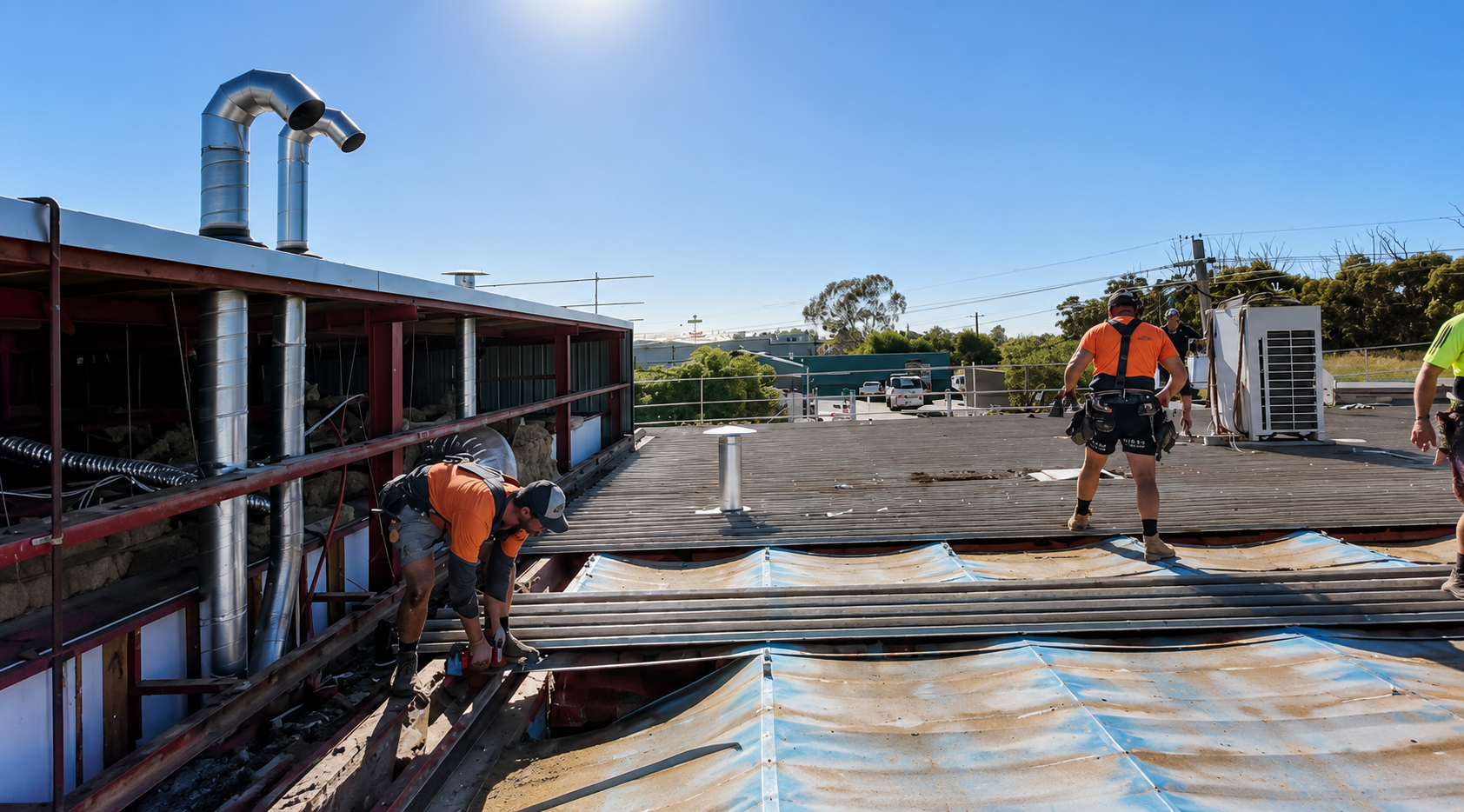
The more you can answer, the closer you are to the right system — and the easier it is for a professional to spec it.
There's no single "best" commercial roofing system — only the best one for your building. The reliable way to get there is a professional assessment that weighs your use, pitch, conditions, and budget, then specs a system engineered to suit. With a design & construct approach, the advice, design, and installation come from one accountable team.
The Right System Starts With Advice
Choosing a commercial roofing system is a decision you live with for decades — too important to guess at. The smartest first step is a conversation with a roofing professional who can assess your building and recommend a system that fits it, your conditions, and your budget.
Commercial Roofing Across the Riverina & Regional NSW
BB Building Services helps businesses across Griffith, the Riverina, and regional New South Wales choose, design, and install the right commercial and industrial roofing system — from new builds and re-roofing to roof replacement. If you're weighing up your options, let's spec it properly.
Request A Free Quote