How Modular Construction Reduces Project Time
On any commercial, industrial, or government project, time is money. Every extra week on site adds cost, delays occupancy, and pushes back the day your building starts earning its keep. Modular construction is one of the most effective ways to compress that timeline — often delivering finished, high-quality buildings in a fraction of the time of traditional on-site construction.
Across Griffith, the Riverina, and regional NSW, projects like workforce accommodation, mining and solar farm camps, site offices, and commercial facilities regularly face tight deadlines, remote locations, and unpredictable weather. Modular building solutions are designed to solve exactly those problems. Here's how moving construction off-site shortens your project timeline — without cutting corners on quality.
- Work happens in parallel. Off-site fabrication runs at the same time as your site works — two jobs at once instead of one after the other.
- Weather stops mattering. A controlled factory keeps the build on schedule while traditional sites lose days to rain, heat, and wind.
- Less rework. Repeatable, quality-controlled processes mean fewer defects and a faster, more predictable handover.
The Timeline, Side by Side
The single biggest saving comes from doing two things at once. On a traditional build, each stage waits for the last one to finish. With modular, your site is being prepared while the building itself is fabricated off-site — so the overall program is far shorter.
Indicative only — actual savings depend on the project. Industry estimates commonly put modular construction at 30–50% faster than traditional methods.
Where the Time Savings Come From
Off-Site and On-Site Work Happen at the Same Time
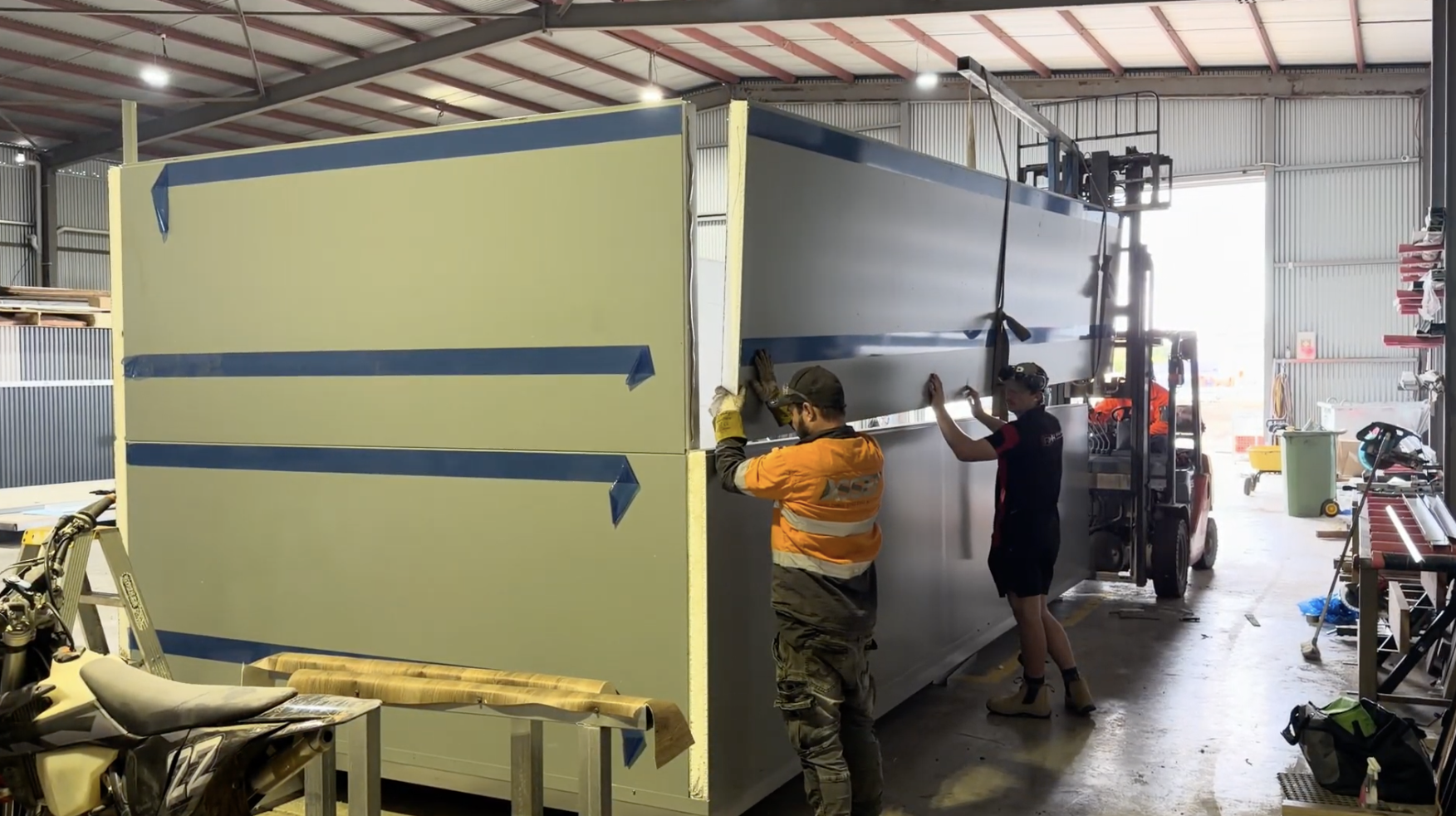
This is the biggest saving. While your site is being cleared, and foundations and services are prepared, the building itself is being fabricated in a factory. The two streams run in parallel rather than one after the other. When the modules are ready, they're transported and craned into place — turning months of sequential work into weeks.
Weather Doesn't Stop the Build
Rain, extreme heat, and wind routinely cost traditional sites days or weeks. Because modular construction happens inside a controlled facility, fabrication keeps moving regardless of what's happening outside. For remote and regional sites — where a wet week can strand a crew — that reliability is a major advantage.
Fewer Defects, Less Rework
Building in a controlled environment with repeatable processes and quality checks at every stage means fewer errors — and errors caught early. Less rework late in the project keeps the schedule tight and the handover predictable, instead of losing time chasing problems after the build is "finished".
A Managed, Predictable Supply Chain
Materials are procured and stored centrally at the fabrication facility rather than trickling in to a remote site. That removes one of the most common causes of delay — waiting on deliveries or trades to arrive at a hard-to-reach location — and keeps the build moving to plan.
Less On-Site Disruption and Coordination
Fewer trades on site and a much shorter on-site presence mean a safer, tidier project with less impact on live operations or the surrounding community. That's particularly valuable for government projects and builds that sit alongside an operating business or public space.
Faster to Occupancy — and Faster Return
The bottom line: modular gets workers housed, site offices operational, and facilities open weeks or months sooner. Every day you shave off the program is a day earlier the asset starts working for you — lower holding costs, earlier revenue, and deadlines met with room to spare.
Built for Projects Where Time Matters Most
Speed is exactly why modular building solutions are the go-to for time-critical, logistically demanding projects. They're ideally suited to workforce accommodation, mining accommodation, and solar farm accommodation on remote sites, to site offices that need to be operational fast, and to government projects working to fixed delivery dates. For commercial and industrial construction where every week counts, off-site delivery keeps the whole program on track.
| Traditional on-site | Modular (off-site) | |
|---|---|---|
| Build timeline | Longer, fully sequential | Up to 30–50% faster (parallel) |
| Weather delays | Frequent | Largely eliminated |
| On-site disruption | Extended | Minimal, short install window |
| Quality control | Site-dependent | Consistent, factory-controlled |
| Speed to occupancy | Slower | Weeks to months sooner |
The more boxes you tick, the more a modular approach is likely to save you time and money.
Faster construction isn't just convenient — it lowers holding costs, brings occupancy and revenue forward, and takes the risk out of your schedule. With a design & construct approach, one team manages the whole process from concept through fabrication to installation, so there's a single point of accountability and no gaps between stages to slow you down.
One Team, From Design to Install
The fastest projects are the best coordinated ones. A design & construct modular solution keeps design, engineering, fabrication, and installation under one roof — removing the handovers and finger-pointing that stall traditional builds, and giving you a clear, committed timeline from day one.
Modular Building Solutions Across the Riverina & Regional NSW
BB Building Services designs and constructs modular buildings, workforce accommodation, and site offices for commercial, industrial, and government projects across Griffith, the Riverina, and regional New South Wales. If you're working to a deadline, let's talk about how a modular approach can get you there faster.
Request A Free Quote